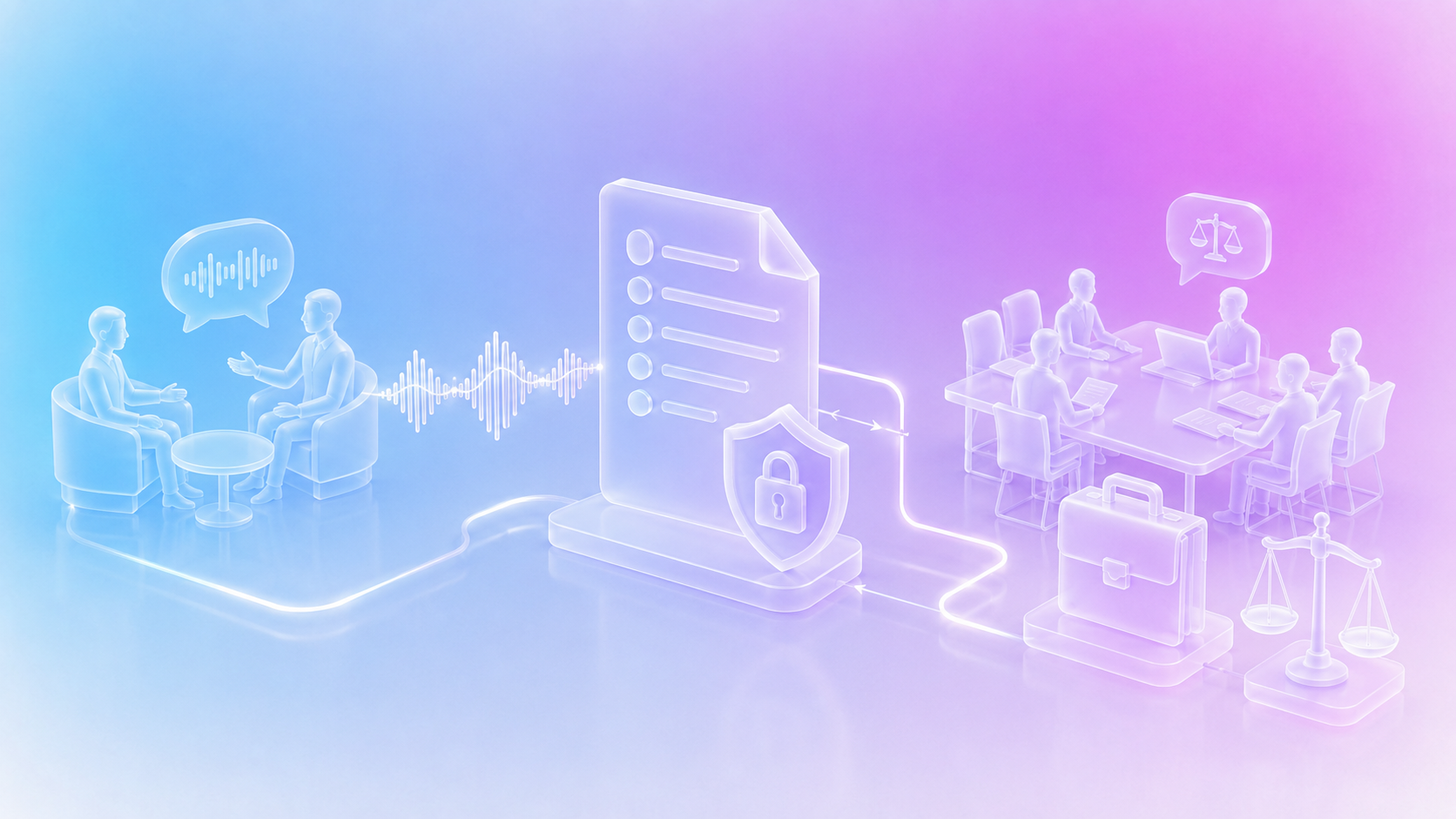
Why Law Firms Need a Different Kind of AI Transcription
Law firms don’t just hold “meetings.”
They conduct client conversations, phone calls, strategy discussions, internal case reviews, settlement negotiations, contract discussions, due diligence calls, board and general meeting minutes, meetings with opposing parties, court or authority preparations, notary meetings, and internal firm sessions.
These generate ongoing information that can be crucial later:
- Facts
- Client instructions
- Legal assessments
- Risks
- Deadlines
- Responsibilities
- Next steps
- Settlement positions
- Outstanding documents
- Evidence
- Procedural steps
- Internal strategy
- Case notes
- Tasks for lawyers, paralegals, or secretariat
In legal work, documentation is not just administration. It is part of case management, quality assurance, traceability, and risk control.
This is exactly where Meeting Metrics comes in.
Meeting Metrics is a Swiss AI solution for law firms, legal services, and legal teams that creates structured transcripts, tasks, summaries, and drafts from client conversations, case notes, dictations, and internal meetings — with Swiss German support, Swiss data hosting, optional on-premise installation, and personal support for implementation, templates, and data protection issues.
Summary: Why Meeting Metrics Is Relevant for Law Firms
Law firms have many conversations but little time for follow-up.
Lawyers, substitutes, paralegals, legal assistants, and secretariats spend a lot of time summarizing conversations, creating case notes, tracking to-dos, monitoring deadlines, documenting meetings, and retrieving information later.
Meeting Metrics helps precisely there.
During the conversation, the focus can be more on the client, opposing party, or team discussion. After the conversation, case notes, tasks, summaries, pending items, and drafts are automatically prepared. Through templates and context files, firms can tailor the results to their own case structures, legal fields, and internal workflows.
The main benefit is not having “a transcript.” The benefit is turning conversations into faster usable legal working materials.
Meeting Metrics does not replace any lawyer or legal assessment. The solution supports preparation, structuring, and follow-up. Responsibility for legal assessments, case strategy, deadline control, final documents, and communication naturally remains with the firm or the responsible specialist.
What Makes Conversations in Law Firms Special?
Conversations in law firms differ from normal business meetings.
It’s not just about updates. It’s about facts, rights, obligations, risks, deadlines, evidence, strategy, litigation chances, confidentiality, and case management.
A normal meeting summary often isn’t enough.
Legal conversation documentation must answer specific questions depending on the situation:
- What exactly did the client describe?
- What instructions were given?
- Which documents are still missing?
- Which deadlines are relevant?
- Which legal risks were mentioned?
- Which next steps were agreed upon?
- Which tasks does the firm take on?
- Which tasks remain with the client?
- Which points need internal review?
- Which topics are confidential or strategically sensitive?
- Which information belongs in the file?
- Which information is suitable for a case note?
- Which points must not be included unchecked in a final document?
Meeting Metrics supports exactly this structured follow-up — always as an assistance system, not a replacement for legal review or responsibility.
Attorney-Client Privilege: Why AI Must Be Introduced Especially Carefully in Law Firms
Confidentiality is central for law firms.
Attorney-client privilege protects not only obvious secrets. It fundamentally concerns information learned within the mandate relationship. That’s why firms must carefully examine how data is processed, stored, and protected when using AI tools, cloud services, transcription, and automatic summarization.
Before deploying an AI solution, firms especially ask these questions:
- What data is recorded?
- What mandate information is processed?
- Where are audio, transcripts, and results stored?
- Who has access?
- Can external providers see data in plain text?
- Are data used for training?
- Which subprocessors are involved?
- Is there a data processing agreement?
- What technical and organizational measures exist?
- How is data deleted?
- Is Swiss data hosting available?
- Is Swiss processing possible?
- Is an on-premise setup possible?
- Which conversations are suitable for AI support?
- Which conversations should be consciously excluded?
Meeting Metrics can support firms here because the solution is designed for Swiss data hosting, enterprise setups with processing in Switzerland, local models, on-premise options, and personal support for implementation and governance.
Typical Roles in a Law Firm
Meeting Metrics is not only aimed at partners. The benefit arises across various roles.
Partners
Partners conduct client conversations, strategy discussions, negotiations, internal case reviews, and business development talks.
Meeting Metrics can help turn conversation content, tasks, open points, and internal follow-ups faster into structured working materials.
Associates and Substitutes
Associates and substitutes prepare conversations, conduct research, draft documents, document case work, and record internal meetings.
Meeting Metrics can help prepare case notes, conversation summaries, and tasks more structurally.
Paralegals
Paralegals coordinate documents, deadlines, data rooms, due diligence lists, signature processes, internal clarifications, and case administration.
Meeting Metrics can extract concrete to-dos, outstanding documents, and pending items from meetings.
Legal Assistants and Firm Secretariat
Firm secretariats and legal assistants are often central hubs for appointments, deadlines, correspondence, invoices, filing, and case administration.
Meeting Metrics can support internal meetings, dictations, phone notes, or follow-ups.
Inhouse Legal Teams
Legal services in companies hold many internal meetings with departments, management, compliance, HR, IT, procurement, or external law firms.
Meeting Metrics can create tasks, risk overviews, decision bases, and management updates from these.
Notaries and Certifying Officers
Notaries hold meetings on contracts, company formations, estates, marriage and inheritance contracts, real estate transactions, or certifications.
Meeting Metrics can structure conversation notes, pending items, missing documents, and next steps. Legal and formal responsibility naturally remains with the responsible certifying officer.
Typical Types of Conversations and Meetings in Law Firms
Client Conversations
Client conversations are often information-rich and complex. They cover facts, goals, risks, documents, costs, strategy, and next steps.
Meeting Metrics can prepare case notes, task lists, open questions, and internal summaries from such conversations.
Typical contents include:
- Initial situation
- Facts
- Client’s goal
- Relevant documents
- Open questions
- Risks
- Deadlines
- Next steps
- Firm’s tasks
- Client’s tasks
Phone Notes
Many important details arise by phone. Even short calls can become relevant later.
Meeting Metrics can help turn phone notes or short dictations into structured case notes.
Internal Case Reviews
Firm teams discuss legal questions, strategy, deadlines, evidence, settlement options, costs, and responsibilities.
Meeting Metrics can create tasks, open points, research questions, and decision bases from these.
Settlement and Negotiation Conversations
Negotiations often include positions, concessions, open points, and next steps.
Meeting Metrics can help document the negotiation status in a structured way. Special confidentiality and careful review are especially important here.
Due Diligence Calls and Transaction Meetings
Many open points, document lists, risks, Q&A topics, and responsibilities arise in transactions.
Meeting Metrics can help structure pending items, document requests, and next steps.
Board and General Meeting Minutes
Many firms support board meetings, general meetings, foundation board meetings, or association meetings.
Meeting Metrics can prepare draft minutes, resolutions, tasks, and open points. Final review and formal responsibility remain with the responsible persons.
Contract Discussions
Contract discussions cover clauses, risks, open points, negotiation positions, and internal approvals.
Meeting Metrics can create a structured task and risk list from the conversation.
Court and Authority Preparation
Before negotiations, hearings, interrogations, or authority contacts, arguments, evidence, and roles are discussed.
Meeting Metrics can document internal preparations, with strategy and confidentiality treated especially carefully.
Firm Meetings
Besides case work, firms also hold internal meetings on personnel, finance, IT, business development, knowledge management, marketing, training, and organization.
Meeting Metrics can create tasks, management updates, and pending items from these.
Recording Sources: Dictation, Smartphone, Desktop App, or Upload
Meeting Metrics is flexible and not limited to a single recording method.
Firms work with dictations, phone notes, online meetings, physical meetings, existing audio and video files, and internal meetings. Meeting Metrics can start exactly there.
Capturing Dictations and Case Notes
Many lawyers already dictate notes after conversations, negotiations, or court hearings.
Meeting Metrics can transcribe such dictations and convert them into structured case notes, task lists, or drafts.
This is especially relevant for:
- Client conversations
- Phone notes
- Negotiation notes
- Court preparation
- Settlement conversations
- Internal strategy discussions
- Deadline and pending lists
Using Smartphone as a Dictation Device
A separate recording device is not necessary.
The mobile app allows the smartphone to be used as a dictation device. This is practical in daily firm life because the smartphone is almost always with you anyway.
This allows short dictations, conversation summaries, case notes, or internal notes to be recorded directly and then processed.
Desktop App for Online Meetings
For Teams, Zoom, Google Meet, or other online meetings, Meeting Metrics can be used via the desktop app.
Recording runs in the background without a visible bot joining the meeting. This is especially convenient for confidential client conversations, internal case reviews, or strategic meetings.
Uploading Audio and Video Files
Existing audio or video files can be uploaded.
This is useful if recordings already exist, for example from dictation devices, mobile recorders, video conferences, or meeting recordings.
Meeting Metrics then transforms these recordings into structured transcripts, case notes, summaries, tasks, or draft minutes.
Continuing Existing Workflows
Meeting Metrics does not have to immediately replace existing firm routines.
A lawyer can continue dictating.
A legal assistant can continue preparing a phone note.
A partner can make a short voice recording after a client conversation.
A team can record an internal case discussion via the desktop app.
An in-house legal team can have an online meeting summarized.
The practical advantage:
- existing dictation processes can be continued
- smartphones can serve as mobile dictation devices
- online meetings can be processed via the desktop app
- audio and video files can be uploaded
- results can be integrated into existing law firm software
- the rollout can be carried out step by step
This way, Meeting Metrics does not become an alien element in everyday law firm life but complements existing documentation processes.
Swiss German and Legal Language
In Swiss law firms, standard German is rarely spoken exclusively.
Client conversations, internal case discussions, and phone calls often take place in Swiss German. At the same time, legal documents are usually written in standard German. Additionally, there are French, Italian, English, technical terms, legal articles, abbreviations, names of courts, authorities, parties, and types of proceedings.
For international AI note-takers, this is often challenging. Many recognize standard German but not reliably Swiss German, legal jargon, or typical mixtures of dialect, standard German, and English.
Meeting Metrics is tailored to the Swiss market and supports Swiss German. This is especially important because an AI solution in law firms must understand not only individual words but also context:
- mandate
- clientele
- opposing party
- deadline
- file note
- evidence
- settlement
- contract
- instruction
- legal claim
- submission
- order
- judgment
- decision
- pending matter
- next steps
Data Protection, Attorney-Client Privilege, and Confidentiality
Data protection is important for law firms. Even more important is attorney-client privilege.
Mandate information can already be sensitive if it appears inconspicuous to outsiders. Even the fact that a mandate exists can be confidential. This includes facts, documents, strategies, settlement positions, internal assessments, drafts, and communication.
Therefore, it is important for law firms to consider:
- Which data is recorded?
- Which mandate information is processed?
- Who has access?
- Where is the data stored?
- Who is the data processor?
- What documents exist regarding TOM, AVV, subprocessors, and data flows?
- How long are audio, transcripts, and results stored?
- Are data used for training?
- How are clients or participants informed?
- Which conversations are suitable for AI support at all?
- Which conversations should be consciously excluded?
- How is attorney-client privilege maintained?
- How is it prevented that confidential data is stored unnecessarily long?
Meeting Metrics can support law firms here because the solution is designed for Swiss data storage, enterprise setups with processing in Switzerland, local models, on-premise options, and personal support for data protection, attorney-client privilege, and governance issues.
Swiss Data Processing, Local Models, and On-Premise Option
Meeting Metrics stores data in Switzerland. For enterprise customers, setups with processing in Switzerland and local models are possible.
For law firms, notaries, legal services, or legal teams with particularly high requirements for attorney-client privilege, data protection, information security, or internal IT specifications, an individual enterprise setup up to an on-premise installation can also be considered.
This allows Meeting Metrics to be operated if necessary in the firm's own infrastructure or in a specifically defined environment.
This is especially relevant for law firms that want to document confidential mandate information, transactions, litigation strategies, internal legal opinions, sensitive personal data, or regulatory demanding mandates and require maximum control over data flows, access, processing, and operation.
Depending on the requirement, different operating models can be distinguished.
Swiss Data Storage
Data is stored in Switzerland. This is already an important basic requirement for many law firms.
Swiss Processing in Enterprise Setup
For more sensitive mandates, processing in Switzerland can also be relevant.
Local Models
For particularly high requirements, local models can be considered to gain more control over processing.
On-Premise Installation
For law firms, legal services, or organizations with particularly high requirements, an on-premise installation can be considered. This allows the solution to be operated in the firm's own or a specifically defined infrastructure.
Typical Data Protection and Governance Requirements of a Law Firm
The following points are typically relevant for the use of Meeting Metrics in law firms.
Data Processing Agreement
If an external provider processes data on behalf of a law firm, a clean contractual basis is required. This includes purpose, scope, instructions, technical and organizational measures, subprocessors, deletion, confidentiality, and control rights.
Attorney-Client Privilege
For mandate data, a normal data protection perspective is often not sufficient. It must be checked how attorney-client privilege is maintained and which providers, employees, or subprocessors could have access to information.
Technical and Organizational Measures
Law firms must be able to understand how data is protected. This includes access controls, encryption, role and rights concepts, logging, backup, deletion, secure transmission, and internal processes.
Data Location and Processing
For law firms, it is important whether data is stored in Switzerland and whether processing is also possible in Switzerland. For particularly sensitive mandates, an enterprise setup with Swiss processing, local models, or an on-premise installation can be relevant.
Transparency Towards Participants
Participants should know if a conversation is recorded or processed with AI. Depending on the type of conversation, mandate, internal regulation, and applicable law, this can be designed differently.
Purpose Limitation and Proportionality
Not every conversation needs to be recorded. Law firms should define for which types of conversations Meeting Metrics is used and for which it is not.
Retention and Deletion
Audio, transcripts, and result documents should not be stored longer than necessary. However, mandate-relevant notes and documents must be correctly filed in the file or the respective law firm system.
Law Firm Software: Where Meeting Metrics Could Integrate Results
Swiss law firms work with various law firm, DMS, time tracking, document, and billing systems. Meeting Metrics does not replace these systems. The added value lies in transforming conversations and dictations into structured results that can then be integrated into existing law firm processes.
Depending on the setup, file notes, protocols, tasks, summaries, or drafts can be exported or transferred via interfaces to existing systems.
WinJur
WinJur is a well-known law firm software for Swiss law firms. It is focused on mandate management, law firm processes, and legal administration.
Meeting Metrics could help here to prepare file notes, conversation summaries, tasks, or mandate notes in a structured way and then integrate them into the corresponding file.
Possible exports or integrations:
- file note
- client conversation summary
- task list
- deadline note
- internal case note
- phone note
- negotiation note
- meeting minutes
Vertec
Vertec is used by many Swiss service companies and law firms for mandate management, time tracking, CRM, project management, and billing.
Meeting Metrics could especially support mandate notes, tasks, follow-ups, and internal meetings here.
Possible exports or integrations:
- mandate summary
- tasks for team members
- conversation note
- business development note
- follow-up from client conversation
- internal pending list
- management update
timeSensor LEGAL
timeSensor LEGAL is law firm software for modern law firm organization, mandate management, documents, time tracking, and invoicing.
Meeting Metrics could complement here by generating structured file notes and tasks from conversations and dictations that can then be integrated into law firm processes.
Legalis, LawDesk, Weblaw, ALAN, Plato, and Other Legal Tech Systems
Depending on the law firm, other systems for mandate management, document management, knowledge management, deadlines, communication, contract automation, or legal operations are used.
Meeting Metrics does not replace these systems. The solution creates structured results from conversations that can then be integrated into existing legal tech or law firm systems.
Microsoft 365, Teams, SharePoint, and Outlook
Many law firms use Microsoft 365 for email, calendar, Teams meetings, documents, storage, and collaboration.
Meeting Metrics can interact here with existing workflows, for example via:
- exports
- share links
- storage processes
- Teams meetings
- tasks
- future integrations
DMS, Network Drives, and Document Storage
Many law firms work with document management systems, network drives, or mandate-related storage structures.
Meeting Metrics can prepare file notes, protocols, tasks, or summaries so that they can be integrated into the correct mandate storage.
What an Integration with Meeting Metrics Can Look Like in Practice
An integration does not always have to be a deep technical interface immediately. Especially in law firms, a step-by-step approach is often more sensible.
Stage 1: Structured Export
Meeting Metrics creates a structured result that is further processed as Word, PDF, text, or via a share link.
This is suitable for law firms that first want to check quality and do not want to change existing processes immediately.
Stage 2: Template-Based Transfer
Meeting Metrics creates results directly in the structure the law firm needs.
For example:
- file note
- phone note
- client conversation summary
- internal case discussion
- negotiation note
- task list
- deadline overview
- board meeting draft minutes
- general meeting draft minutes
- due diligence pending list
- management update
This reduces copy-paste and improves consistency.
Stage 3: API or Interface Connection
For larger law firms, legal services, or legal operations teams, Meeting Metrics can be connected via API or defined interfaces.
Thus, reviewed summaries, tasks, or file notes could be transferred to existing law firm, DMS, or mandate management systems.
Important: Especially for mandate data, the transfer should be controlled. The responsible specialist reviews and confirms the content before it is integrated into the file or a law firm system.
Stage 4: Enterprise Setup with Swiss Processing or On-Premise
For particularly sensitive mandates, an enterprise setup with Swiss processing, local models, or on-premise installation can be considered.
This is especially relevant for:
- Litigation mandates
- M&A transactions
- internal investigations
- criminal defense
- labor law conflicts
- family law mandates
- compliance investigations
- regulated industries
- banks, insurance and healthcare
- public clients
- especially confidential board mandates
Where Meeting Metrics can specifically support
Meeting Metrics can create added value for law firms on several levels.
Create file notes faster
Structured file note drafts arise from client meetings, phone calls, or internal case discussions.
Extract tasks and pending items
Meeting Metrics recognizes tasks, responsibilities, outstanding documents, and next steps.
Make deadlines and open points more visible
Deadlines must still be professionally checked and integrated into the official deadline process. However, Meeting Metrics can help make deadline-relevant hints from conversations more visible.
Make mandate knowledge searchable
Through AI chat and search, previous conversations can be queried more easily.
Examples:
- What has the client said about the matter?
- Which documents are still missing?
- Which risks were discussed in the initial meeting?
- Which tasks has the client taken on?
- What was decided in the last internal case discussion?
- Which points are still open before submission?
- What was offered in the settlement discussion?
- Which topics have been open for several meetings?
Document internal meetings
Law firms can more efficiently follow up on internal meetings about organization, HR, IT, business development, knowledge management, or finance.
Improve mandate handovers
When people are absent or mandates are handed over, Meeting Metrics can help make conversation knowledge and open points more quickly accessible.
Use cases for law firms
1. Summarize client meetings
Client meetings often contain many details, goals, and open questions. Meeting Metrics can prepare a structured summary and file note from them.
2. Automatically prepare phone notes
Short phone calls can be relevant later. Meeting Metrics can convert spoken notes into clean phone notes.
3. Document internal case discussions
Law firm teams can record legal questions, strategy, research assignments, and next steps more efficiently.
4. Structure negotiation notes
Settlement and negotiation discussions contain positions, commitments, open points, and next steps. Meeting Metrics can help prepare these contents.
5. Manage due diligence pending items
Many open documents, questions, and tasks arise in transactions. Meeting Metrics can extract pending items and responsibilities.
6. Prepare board and general meeting minutes
Law firms that accompany board or general meeting minutes can prepare draft minutes, resolutions, and tasks faster.
7. Use dictations for file notes
Lawyers can dictate directly after meetings and have structured file notes created from them.
8. Reduce knowledge loss
When team members change, are absent, or a mandate is handed over, much context is often lost. Meeting Metrics helps make conversation knowledge more findable.
Economic benefits: What Meeting Metrics specifically brings to a law firm
The economic benefit of Meeting Metrics does not arise from replacing legal professionals but from better support in everyday work.
Lawyers, paralegals, legal assistants, and secretariats remain professionally responsible. However, Meeting Metrics helps reduce repetitive follow-up work, prepare file notes faster, capture tasks more structurally, and find mandate knowledge better.
This is especially important in law firms because many teams simultaneously have to meet high quality standards, tight deadlines, complex mandates, and administrative burdens.
Example calculation: Medium-sized law firm
Let's consider a law firm with 15 to 30 employees, several practice groups, and ongoing mandates.
Typical volume of conversations and meetings per month:
- Client meetings
- Phone calls
- Internal case discussions
- Negotiations
- Contract discussions
- Due diligence calls
- Board or general meeting minutes
- Law firm meetings
- Business development discussions
In practice, this can quickly result in 50 to 150 documentation-relevant conversations per month. Not every conversation requires a formal protocol, but many need at least a file note, task list, summary, or pending overview.
If currently only 10 to 30 minutes of follow-up work are required per conversation, this already results in considerable effort. For complex client meetings, negotiations, or internal case discussions, the effort can be significantly higher.
Meeting Metrics does not completely eliminate this effort. That would not be the right expectation. Legal review, professional quality, strategy, and final approval remain with the responsible person.
But the starting point improves significantly.
Instead of starting from scratch, law firm teams receive a structured basis:
- File note draft
- Conversation summary
- Task list
- Outstanding documents
- Deadline hints
- Research questions
- Next steps
- Negotiation note
- Mandate status
- Searchable mandate knowledge
If a law firm saves an average of 15 minutes of follow-up work per 80 relevant conversations per month, this results in 20 hours of relief per month.
If an average of 30 minutes is saved for more complex conversations, it is already 40 hours per month.
This time can be used where it is more valuable:
- Legal analysis
- Strategy
- Mandate management
- Client care
- Negotiations
- Quality assurance
- Acquisition
- Training of junior staff
- Internal organization
More quality instead of just less effort
The benefit is not only reflected in hours.
Meeting Metrics can also improve the quality of follow-up work:
- File notes are available faster.
- Tasks are assigned more clearly.
- Outstanding documents are less likely to be lost.
- Mandate knowledge remains more findable.
- Internal case discussions become more structured.
- Handovers become easier.
- Phone notes become more consistent.
- Follow-ups are prepared faster.
- Law firm meetings lead to clearer next steps.
The economic benefit does not lie in replacing people. It lies in relieving qualified employees from repetitive raw work and giving them more time for demanding legal work.
Everyday life in law firms: Why time savings matter
Law firms are under pressure.
Mandates become more complex, deadlines remain tight, clients expect quick responses, fee pressure increases, and at the same time, the demand for quality, confidentiality, and diligence remains high.
Meeting Metrics relieves where particularly much manual work arises: in dictations, file notes, conversation summaries, and internal protocols.
For law firms, this means: less time for raw notes and follow-up – more time for analysis, advice, strategy, and client work.
Which conversations are particularly suitable?
Meeting Metrics is particularly suitable for situations where a concrete result is needed after the conversation.
These include:
- Client meetings
- Phone notes
- Internal case discussions
- Contract discussions
- Negotiation preparations
- Settlement discussions
- Due diligence calls
- Board and general meeting minutes
- Law firm meetings
- Business development discussions
- Compliance meetings
- Internal legal service meetings
- Notary meetings
- Mandate handovers
Less suitable are conversations where particularly confidential information would be processed without clear information, without a defined purpose, or without an agreed law firm governance concept. Especially process strategy, criminal defense, internal investigations, family law conflicts, or highly sensitive transactions should be reviewed particularly carefully.
Why law firms do not need a generic AI notetaker solution
Many AI notetakers are built for sales, recruiting, or remote teams.
Law firms have different requirements.
A sales team might need conversation summaries and CRM updates. A law firm needs file notes, mandate context, deadlines, document lists, strategy hints, tasks, confidentiality, attorney-client privilege, and controlled filing.
An international tool might understand "Meeting Summary." But a Swiss law firm needs:
- File note
- Client meeting
- Instruction
- Deadline hint
- Facts
- Evidence
- Legal question
- Negotiation position
- Settlement proposal
- Contract risk
- Outstanding documents
- Pending list
- Internal case discussion
- Procedural step
- Mandate status
- Next steps
- Responsible person
- Deadline
- Law firm governance
Meeting Metrics is therefore not just an AI notetaker but a solution that can adapt to the working methods of Swiss law firms and legal departments.
Introduction in the law firm: Test first, then roll out properly
The use of AI in law firms should be pragmatic and controlled.
Therefore, a clearly defined entry is recommended. Law firms can first test Meeting Metrics in a pilot, assess the quality, and then decide how to design a rollout sensibly.
1. Test Enterprise for two weeks
A law firm can initially test Meeting Metrics for two weeks in the Enterprise setup. This phase is not about immediately switching all mandate conversations. It is about realistically assessing the quality.
Typical tests can be:
- an internal law firm meeting
- an internal case discussion
- a dictation for a file note
- an anonymized or less sensitive client context
- a business development conversation
- a contract review call
- a draft board of directors protocol
- a due diligence pending items list
- a telephone note
This quickly shows the firm how well transcription, Swiss German, summarization, tasks, file note templates, and legal structure work.
2. Convince with quality
After the initial tests, the following can be checked:
- How well does Meeting Metrics understand Swiss German?
- How useful is the file note?
- How well are tasks recognized?
- How well are open documents identified?
- How well do the results fit the firm's own structure?
- Which templates need to be adjusted?
- Which types of conversations are particularly suitable?
- Which types of conversations should be consciously excluded?
- How well does the review process by lawyers work?
- How well can results be integrated into existing law firm software?
This phase is important so that Meeting Metrics is not evaluated theoretically but based on real law firm situations.
3. Optimize templates together
Afterwards, the most important templates can be adjusted.
For example:
- File note
- Client conversation
- Telephone note
- Internal case discussion
- Negotiation note
- Contract review
- Due diligence pending items list
- Board of directors protocol
- General meeting protocol
- Law firm meeting
- Business development note
- Management update
The better the template, the better the result. Meeting Metrics supports law firms in adopting existing workflows and preparing them sensibly for AI.
4. Clarify data protection, attorney-client privilege, and operating model
At the same time, it should be clarified which data protection, attorney-client privilege, and IT requirements apply.
This includes:
- Data processing agreement
- Technical and organizational measures
- Subprocessors
- Data location
- Swiss processing
- Retention and deletion
- Access rights
- Information obligations
- Client confidentiality
- Use of data for training
- Operating model
- Local models
- On-premise option
- Integration into law firm software or DMS
For particularly sensitive mandates, it can be checked whether an enterprise setup with Swiss processing, local models, or on-premise installation makes sense.
5. Onboarding on site
Personal onboarding is particularly valuable for law firms.
Meeting Metrics can conduct onboarding on site if needed. This is not only about operating the software but also about practical tips from everyday law firm life.
For example:
- Which types of conversations are suitable for the start?
- How to properly inform conversation participants?
- How to start and stop recordings correctly?
- How to use dictations for file notes?
- How to create better templates?
- How to efficiently review AI results?
- How to organize team folders and access rights?
- How to avoid unnecessary data retention?
- How to work with tasks, pending items, and AI chat?
- How to separate internal law firm meetings from client work?
- Which content should not be recorded?
- How can results be integrated into law firm software?
The goal is not only to show the software. The goal is for the firm to quickly find a secure, accepted, and meaningful work process.
6. Gradual rollout
After the pilot, Meeting Metrics can be rolled out gradually.
A sensible sequence might be:
- first internal law firm meetings and dictations
- then internal case discussions
- then selected client conversations
- then board/general meeting protocols or transaction meetings
- later exports or interfaces to existing law firm software
- for particularly sensitive mandates only after additional review
This keeps the introduction controlled and allows the firm to gain experience before adding further areas.
Example: This is how a workflow for a client conversation could look
Before the conversation, the responsible person uploads relevant context information or a conversation structure.
During the conversation, Meeting Metrics runs in the background via the desktop app or, for physical conversations, via the mobile app, provided this is regulated internally and transparent to the participants.
After the conversation, Meeting Metrics creates a structured summary with facts, open questions, tasks, missing documents, and next steps.
The lawyer reviews the result, adds legal assessments, and decides which information is filed as a file note.
Later, the team can ask via the AI chat:
- What did the client say about the facts?
- Which documents are still missing?
- Which deadlines were mentioned?
- Which risks were discussed?
- Which tasks lie with the firm?
- Which tasks lie with the client?
Example: This is how a workflow for an internal case discussion could look
The team discusses a legal question, evidence, strategy, or deadline situation.
Meeting Metrics then creates a structured internal note with tasks, research points, open questions, and next steps.
The responsible person reviews the draft and decides what is documented in the file.
This keeps the discussion traceable without having to manually write everything down during the conversation.
Example: This is how a workflow for a dictation could look
After a phone call, a lawyer dictates a short summary via the mobile app.
Meeting Metrics creates a file note from this with:
- Conversation partner
- Topic
- Key statements
- Open points
- Tasks
- Next steps
- Possible deadline notes
The note is reviewed, adjusted, and then added to the client file.
Benefits for Swiss law firms
Less manual post-processing
The AI prepares file notes, protocols, tasks, and summaries. This saves time in post-processing.
Support instead of replacement
Meeting Metrics supports lawyers, paralegals, legal assistants, and secretariats in the raw work. Legal review, professional quality, and final responsibility remain with the firm.
Better conversation quality
Lawyers can focus more on clients, opposing parties, or strategy instead of writing everything down in parallel.
More traceability
Conversation content, tasks, open documents, and next steps are recorded more structurally.
Faster availability
File notes, pending item lists, or summaries can be available faster. This helps law firm teams, clients, and internal collaboration.
Swiss German support
Meeting Metrics is tailored to the Swiss market and also understands Swiss German.
Swiss data storage and on-premise option
Data is stored in Switzerland. For enterprise customers, setups with processing in Switzerland, local models, or on-premise installation are possible. This is especially relevant for firms with high requirements for attorney-client privilege, data protection, information security, and control over sensitive client data.
Custom templates
Firms can use their own templates for file notes, client conversations, telephone notes, negotiation notes, board protocols, general meeting protocols, or internal case discussions.
Personal support
Introduction, rollout, templates, data protection, attorney-client privilege issues, and integration options can be clarified together.
Onboarding on site
If needed, Meeting Metrics can accompany law firms on site and provide practical tips for dictation, templates, recording processes, confidential use, exports, and internal introduction.
No visible bots
Meeting Metrics runs in the background via desktop or mobile app. This is especially pleasant for confidential client conversations and internal case discussions.
No additional recording device needed
The desktop app is sufficient for online meetings. For dictations, physical conversations, or spontaneous notes, the smartphone with the mobile app is sufficient.
Which firms is Meeting Metrics suitable for?
Meeting Metrics is suitable for small, medium, and larger law firms, boutique firms, corporate law firms, notaries, in-house legal teams, legal services, compliance teams, and legal consultancies.
Particularly relevant is the solution for organizations that:
- regularly document client conversations
- want to create file notes faster
- want to structure telephone notes
- document internal case discussions
- prepare board or general meeting protocols
- use Swiss German
- have high confidentiality requirements
- want to continue using existing law firm software
- do not want additional recording hardware
- do not want visible bots in conversations
- want to make mandate knowledge from past conversations more findable
Frequently asked questions from law firms
Is Meeting Metrics suitable for law firms?
Yes. Meeting Metrics is suitable for firms that want to structure client conversations, file notes, telephone notes, internal case discussions, negotiations, or law firm meetings.
Does Meeting Metrics replace lawyers?
No. Meeting Metrics does not replace legal review, mandate strategy, or legal responsibility. The solution creates a structured basis and supports post-processing.
Can Meeting Metrics create file notes?
Yes. Meeting Metrics can create draft file notes from dictations, conversations, or telephone notes. These should be reviewed and approved by the responsible professional.
Can Meeting Metrics summarize client conversations?
Yes. Meeting Metrics can summarize client conversations and structure facts, open questions, tasks, missing documents, and next steps. Use should be regulated internally and transparent to participants.
Does Meeting Metrics understand Swiss German?
Yes. Meeting Metrics is tailored to the Swiss market and supports Swiss German. This is especially important for client conversations, internal case discussions, and telephone notes in Switzerland.
Where is the data stored?
Meeting Metrics stores data in Switzerland. For enterprise customers, setups with processing in Switzerland, local models, or an on-premise installation are possible. This allows law firms to choose a suitable operating model depending on confidentiality, IT strategy, and mandate sensitivity.
Is an on-premise installation possible?
Yes. For law firms, legal services, or organizations with particularly high requirements for data protection, attorney-client privilege, information security, or internal IT guidelines, Meeting Metrics can be considered as an individual enterprise setup with on-premise installation.
Is the use of AI compatible with attorney-client privilege?
Use can be possible if data protection, attorney-client privilege, order processing, access, data location, confidentiality, purpose limitation, retention, and deletion are properly regulated. Law firms should carefully examine the specific use case and operating model.
Are data used for training?
It is crucial for law firms that mandate data is not used for model training. This should be contractually and technically clarified in the specific setup.
Can a law firm test Meeting Metrics first?
Yes. Law firms can initially test Meeting Metrics in the enterprise setup, for example for two weeks. During this phase, dictations, internal meetings, or selected conversations can be processed, templates checked, and quality assessed.
Is on-site onboarding available?
Yes. On-site onboarding is possible for law firms. This includes not only explaining the functions but also providing practical tips on dictation, file notes, templates, attorney-client privilege, recording processes, exports, and internal introduction.
Does Meeting Metrics also work for physical conversations?
Yes. Meeting Metrics can be used for physical conversations, dictations, or on-site meetings via the mobile app.
Does Meeting Metrics work with Microsoft Teams or Zoom?
Yes. Meeting Metrics can be used for online meetings, including via the desktop app. The solution is not limited to a single meeting platform.
Can Meeting Metrics be connected with WinJur, Vertec, or timeSensor LEGAL?
Meeting Metrics does not replace these systems. However, the solution can structure and export results. Depending on the setup, interfaces, exports, or integrations into law firm, DMS, or mandate management systems are conceivable.
Are contents automatically written into the file?
Not without review. Especially with mandate data, it is important that lawyers or responsible specialists review, correct, and approve contents before they are transferred into the file or a law firm system.
Can Meeting Metrics delegate tasks to paralegals or secretariat?
Yes. Meeting Metrics can extract tasks, pending items, and responsibilities from conversations or meetings. These can be exported or integrated into existing task and workflow processes depending on the setup.
Is deep technical integration immediately necessary?
No. Many law firms start with structured exports, templates, and manual transfer. Afterwards, it can be evaluated whether an API or interface integration makes sense.
Can Meeting Metrics use different legal templates?
Yes. Law firms can work with individual templates, for example for file notes, client conversations, telephone notes, internal case discussions, negotiation notes, board minutes, or due diligence pending lists.
Does Meeting Metrics require additional hardware?
No. For online meetings, there is the desktop app. For dictations, physical conversations, or spontaneous notes, the mobile app can be used. Law firms do not need to purchase or manage additional recording devices.
How quickly does a law firm see the benefits?
Often a short pilot with real dictations, internal meetings, or selected conversations is enough to assess quality and time savings. Internal case discussions, file note dictations, telephone notes, law firm meetings, or board/general meeting minutes are particularly suitable.
Conclusion: AI protocols must fit everyday law firm work
Swiss law firms do not need a generic AI notetaker solution.
They need a solution that understands legal everyday life:
- Client conversations
- File notes
- Telephone notes
- Internal case discussions
- Negotiations
- Contract discussions
- Due diligence calls
- Board and general meeting minutes
- Deadlines
- Pending items
- Attorney-client privilege
- Data protection
- Swiss German
- Existing law firm software
Meeting Metrics supports law firms in documenting conversations more efficiently, preparing file notes faster, recording tasks better, and making mandate knowledge usable in the long term.
The most important difference is not in transcription.
It's about what happens after the conversation.
With Meeting Metrics, dictations, conversations, and meetings become structured file notes, protocols, tasks, pending items, and reusable mandate knowledge. For particularly sensitive mandates, Swiss data storage and processing, local models, and on-premise setups are also possible.
Secure, structured, and suitable for Swiss law firms.
Ready for less post-processing in the law firm?
With Meeting Metrics, you can focus more on mandate work, analysis, strategy, and client care again. File notes, protocols, tasks, and summaries are created automatically in the background.
Whether client conversation, telephone note, internal case discussion, contract discussion, board minutes, or physical conversation on site: Meeting Metrics runs via desktop and mobile app on the devices you already use.
Law firms can test Meeting Metrics for two weeks in the enterprise setup, evaluate real dictations or meetings, convince themselves of the quality, and then gradually introduce it. On-site onboarding is available on request – including tips on file notes, templates, attorney-client privilege, recording processes, exports, integrations, and rollout.
For particularly sensitive mandates, Swiss processing, local models, or an on-premise installation can be considered.
Test Meeting Metrics for free or schedule a demo for your law firm.
Questions? Write to us at info@meetingmetrics.ai.