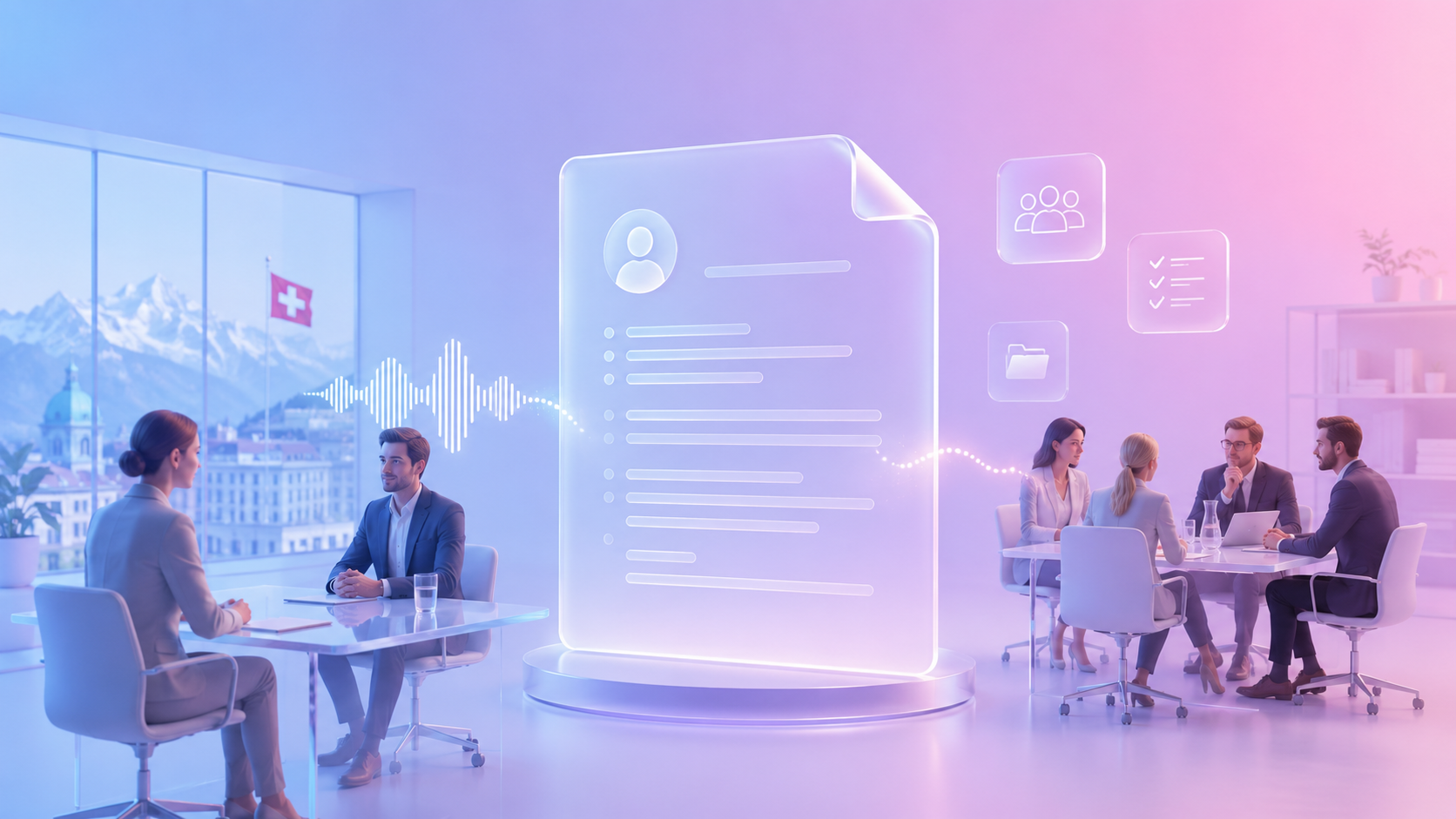
Law firms document a lot: client conversations, negotiations, internal meetings – everything must be recorded in a legally compliant manner. AI transcription can bring enormous time savings here. But are lawyers even allowed to use it?
The short answer: Yes – if the right precautions are taken.
The most important points in brief
- Lawyers have special requirements: client confidentiality, professional rules, documentation obligations
- AI transcription is legally possible if data protection and consent are in order
- US cloud services are problematic – Swiss hosting facilitates compliance
- Time savings per client conversation: 30–60 minutes
- Meeting Metrics offers Swiss data sovereignty and on-premise solutions for the highest requirements
The dilemma
Lawyers spend a lot of time on documentation:
- Recording client conversations
- Summarizing negotiations
- Creating file notes
- Documenting meetings with colleagues
This costs valuable time – either unpaid time or costs that clients have to bear. AI transcription could help – but concerns exist:
- What about client confidentiality?
- Where do the data end up?
- Is it even allowed?
Legal foundations
Client confidentiality (Art. 13 BGFA)
Professional secrecy is absolute. Client information must not reach third parties. With AI transcription, the question arises: Is the provider a "third party"?
- Cloud service with provider access: problematic
- Order processing with contract: permitted
- Local processing without external data transfer: unproblematic
Consent of conversation partners
Before each recording, the consent of all participants is required. Practice: Inform at the beginning of the conversation and document the consent.
Data protection (DSG/GDPR)
Transcriptions contain personal data. You need:
- Legal basis (consent or legitimate interest)
- Technical and organizational measures
- Additional protective clauses for third-country transfers
Why US cloud services are problematic
Many AI transcription tools come from the USA (e.g., Fireflies, Rev, Descript). For lawyers, this entails risks:
- US CLOUD Act: Authorities can demand access to data even if servers are located in Europe – problematic for client confidentiality
- No adequate data protection level: USA is considered an unsafe third country
- Use for AI training: Client data could be used for model improvements – a no-go
The Swiss solution
Swiss hosting solves many of these problems:
- Swiss data protection law applies
- No access by US authorities
- Adequate data protection level from EU perspective
- Order processing contract under Swiss law
What Meeting Metrics offers
- Swiss data sovereignty: All data are processed and stored in Switzerland
- No use for AI training: Client data remain client data
- Order processing contract: Standard DPA available, customizable for law firms on request
- Enterprise on-premise: Processing can be done entirely on own infrastructure – no external API calls
Practical implementation
Step 1: Obtain consent
At the beginning of each conversation:
"I would like to record and transcribe our conversation to create an accurate protocol. The recording will be processed on Swiss servers and used only for the mandate work. Is that okay?"
Document the consent in the file.
Step 2: Start recording
With the Meeting Metrics desktop app:
- Video calls: App runs in the background
- On-site conversations: External recording or smartphone app (coming soon)
Step 3: Check transcription
- Complete transcript with speaker recognition
- AI summary
- Extracted action items
Check the transcript for accuracy before adding it to the file.
Step 4: Transfer to law firm system
Relevant content can be exported to the document management system (DMS).
Concrete time savings
Manual:
- During the conversation: taking notes
- After the conversation: 30–60 minutes for clean copy
With AI transcription:
- During the conversation: full concentration on client
- After the conversation: 5–10 minutes review
Savings: 30–50 minutes per conversation – with multiple conversations per day, this adds up significantly.
Use cases in the law firm
- Client conversations: initial meetings, conference calls, discussions
- Negotiations: precise documentation of who said or agreed what
- Internal meetings: team meetings, case discussions
- Witness interviews: verbatim documentation important
- Continuing education: transcribing CLEs, webinars, lectures for review
Best practices for law firms
- Document consents
- Define retention periods
- Train employees
- Check transcripts before sharing
Conclusion: AI transcription is possible for lawyers
With the right precautions:
- Consent of all participants
- Swiss hosting instead of US cloud
- Clear internal processes
- On-premise solutions for highest requirements
Client confidentiality remains protected, data protection is fulfilled, and you save valuable time.
Frequently asked questions
Am I allowed to record client conversations?
Yes – with the client's consent.
What about conversations with the opposing party?
Here too: consent required, inform before recording.
Is Swiss hosting really secure enough?
For most law firms, yes. For highest requirements, there are on-premise solutions.
What does Meeting Metrics cost for law firms?
Enterprise solution from CHF 200/month, on-premise on request.