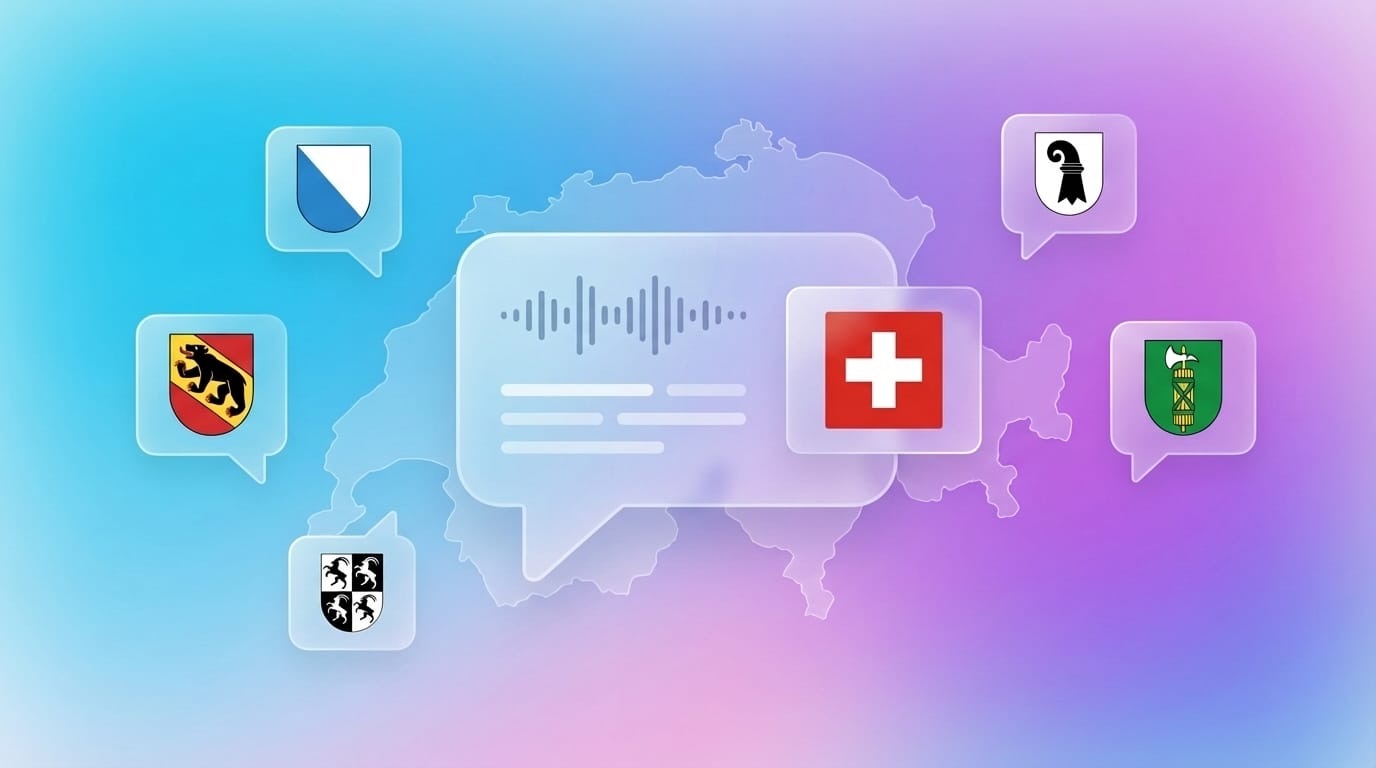
Züritüütsch, Bärndütsch, Baseldytsch or Eastern Swiss dialect: In Swiss meetings, Standard German is rarely spoken consistently. This is exactly the challenge for many transcription solutions.
What works reliably with Standard German quickly becomes inaccurate with dialect. The result: minutes with errors that cause more work afterwards than they save.
But why is Swiss German so difficult for AI — and how well does transcription really work today?
The Key Points in Brief
- Swiss German is difficult for AI to transcribe
- Reasons include lack of writing standards, dialect diversity, and limited training data
- Modern systems today deliver usable results for business meetings
- The combination of transcription, summarization, and speaker recognition is crucial
- Meeting Metrics is optimized for the Swiss market and also works with everyday dialect
Why Swiss German Is So Difficult for AI
Swiss German is not a classic "dialect" but rather a collection of many variants. This makes speech recognition challenging.
No Uniform Spelling
A sentence like "Ich weiss nicht" can be written differently depending on the region:
- I weiss nöd
- I weis nid
- I waiss nit
- I woss ned
There is no binding standard. For AI, this means: There is no "one correct" transcription.
Large Regional Differences
Between Zurich, Bern, Basel, or Central Switzerland, there are clear differences in pronunciation and word choice. Even within a canton, people speak differently.
Less Training Data
AI models work better the more data is available. For English or Standard German, there are huge datasets. For Swiss German, significantly fewer.
Code-Switching in Everyday Life
In many meetings, there is switching between dialect, Standard German, and English — sometimes in the middle of a sentence.
This further complicates recognition.
What Modern Transcription Can Achieve Today
Despite these challenges, much has happened in recent years.
For most business meetings today, the following applies:
- Dialect is recognized and reproduced understandably
- Content is sensibly structured
- Important statements can be reliably extracted
However, it is important:
The expectation should not be a "perfect word-for-word transcript" but usable conversation documentation.
Why Transcription Alone Is Not Enough
A common mistake: focusing only on the transcript.
In practice, what happens afterwards is crucial:
- Summaries
- Action items
- Clear structure
- Speaker attribution
This is especially relevant for Swiss German.
Because even if individual words are not perfectly recognized, the context of the conversation usually remains correct.
How Meeting Metrics Handles This
Meeting Metrics is designed for exactly this reality:
- Reliably recognizes Swiss German in typical business settings
- Converts dialect into readable Standard German
- Combines transcription with structured summarization
- Uses speaker recognition and voice profiles
- Works for online and on-site conversations
The focus is not on perfect dialect spelling —
but on usable results in everyday life.
What "Transcribing Swiss German" Specifically Means
An important point:
Swiss German is usually transcribed into Standard German.
Why?
- No standardized dialect writing
- Better readability
- Easier to share and search
Example:
Spoken:
"Mir müend das Agebot no fertig mache bis am Fritig."
Transcribed:
"Wir müssen das Angebot noch fertig machen bis am Freitag."
This is the most practical form.
How You Can Significantly Improve Quality
Technology is only part of it. The recording itself plays a big role.
1. Good Audio Quality
The clearer the audio, the better the result.
This is even more important for dialect than for Standard German.
2. Normal Speaking Pace
Very fast or chaotic speaking reduces accuracy.
3. Use Voice Profiles
With voice profiles, recurring speakers are better recognized — even with dialect.
4. Quick Review
A quick check for important meetings is usually enough to correct final inaccuracies.
Why Summaries Are Often More Important Than the Transcript
An interesting effect:
Even if individual words in the transcript are not perfect, the summaries are often surprisingly precise.
The reason:
Modern AI understands context — not just individual words.
This means:
- Content remains correct
- Decisions are recognized
- Tasks are extracted
For everyday use, this is often more important than perfect word accuracy.
Why This Is Especially Relevant for Swiss Companies
Several factors come together in Switzerland:
- Dialect instead of standard language
- Multilingual meetings
- High data protection requirements
- Frequent on-site conversations
A solution must cover exactly this combination — not just part of it.
Conclusion: Swiss German Works – With the Right Expectations
Perfect dialect transcription does not exist.
But it is not necessary either.
What counts is:
- Understandable documentation
- Clear summaries
- Clean tasks
- Consistent follow-up
Modern tools reliably deliver exactly this today.
And Meeting Metrics is designed for exactly that.
Frequently Asked Questions
Is Swiss German transcribed in dialect or Standard German?
In Standard German. This is more readable and consistent.
Does it also work in mixed meetings?
Yes. Language switching between dialect, Standard German, and English is recognized.
How accurate is the transcription?
It depends on dialect, audio quality, and speaking style. In typical business meetings, the results are already very usable today.
Can I improve the quality?
Yes — with a good microphone, clear recording, and quick reviews in important meetings.
Is Swiss German even meaningfully automatable?
Yes. Not perfect, but absolutely sufficient for productive conversation documentation.