Meeting AI has mainly done one thing in recent years: documented.
Transcripts, summaries, notes.
That was a clear step forward. But only the first step.
In 2026, the market will shift noticeably. Providers like Microsoft and Zoom are going beyond mere documentation.
It's no longer just about recording what was said.
It's about turning that into concrete work.
The real problem starts after the meeting
Many teams optimize their meetings.
Fewer participants, clearer agenda, shorter duration.
And yet a big problem remains:
The follow-up.
After the meeting, questions arise such as:
- Who does what by when?
- What was decided definitively?
- What needs to be documented or passed on?
- What belongs in the CRM or project tool?
This is exactly where most operational friction arises.
Not during the conversation itself.
But afterwards.
Why transcription alone is not enough
Transcription is important. Nothing works without a clean foundation.
But it only solves part of the problem.
A transcript tells you what was said.
But it doesn't take work off your hands.
The same applies to many summaries.
They are faster to read but often not directly usable.
The crucial difference is therefore not the quality of documentation.
But the usability of the results.
The next development stage: From understanding to action
The market is currently moving from documentation to execution.
This means:
- Results are not only recorded
- they are structured
- and translated into next steps
This is where so-called agentic workflows come into play.
The term is secondary.
What matters is what it stands for:
Meeting AI no longer just helps with note-taking.
It helps with follow-up work.
A simple classification: Capture, Insight, Action
To make this development tangible, we at Meeting Metrics use a simple model:
Capture → Insight → Action
It is not a theoretical framework.
But a practical view of how Meeting AI works in everyday life.
Capture
Transcription, summary, and structured documentation.
The problem "What was said?" is solved.
Insight
Information becomes searchable and usable.
For example, via a chat function:
- What did we discuss with customer X?
- What decisions were made?
- Which topics repeat?
Here, documentation becomes context.
Action
The crucial phase.
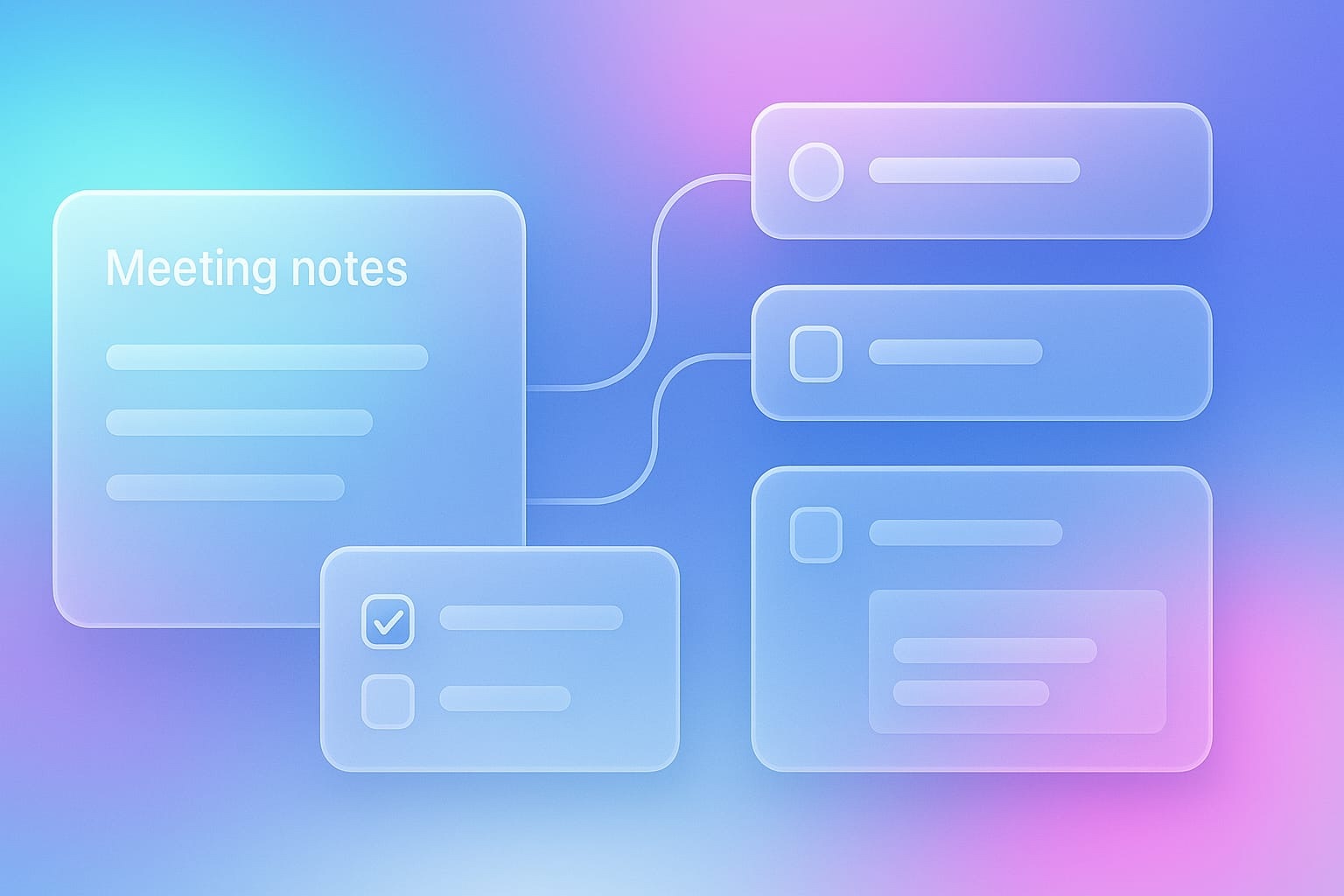
Here, context becomes concrete work:
- To-dos are derived
- Responsibilities become clear
- Next steps are prepared
- Content is reused
This is exactly where real added value arises.
Why this phase determines ROI
Many tools today focus strongly on Capture.
Some move towards Insight.
But the real business impact only arises in Action.
Because this is where what companies really care about happens:
- Less manual follow-up
- Fewer coordination loops
- Clearer responsibilities
- Faster implementation
Or simply put: less friction.
Where the hype overdoes it
Not every "agent" is a real gamechanger.
Often it is a combination of:
- Summary
- Task extraction
- Template logic
- Simple automation
That makes sense. But it's not an autonomous system.
Especially in the meeting context, there are clear limits:
- Not every statement is an assignment
- Not every idea is a decision
- Context is often crucial
Therefore, control is central.
What really matters in practice
As soon as Meeting AI does more than document, requirements increase.
Important questions are:
- Can I trace how a to-do was created?
- Can I review results before they are reused?
- Is it clear what was recognized automatically?
- Does it fit our processes and requirements?
This is especially crucial in the DACH region.
Companies don't want a black box.
They want support they can control.
Why this is especially relevant for Swiss companies
Swiss teams usually have three clear requirements:
- Real time savings
- High traceability
- Clean data protection and hosting options
This makes implementation more demanding.
But also much more sensible.
Because follow-up of meetings is often underestimatedly expensive:
- Scattered notes
- Unclear responsibilities
- Additional coordination
- Inefficient handovers
If exactly this part improves, real benefit arises.
Where Meeting Metrics comes in
Meeting Metrics deliberately follows the logic of Capture, Insight, and Action.
Capture
Meetings are automatically transcribed and structurally summarized.
Insight
Via the chat function, teams can quickly find information and understand connections.
Action
The focus is increasingly on this phase:
Preparing results so they can be directly reused.
For example:
- Clear to-dos instead of loose notes
- Structured follow-ups
- Content that can be directly transferred to CRM or internal systems
Added to this is what is crucial for many Swiss companies:
- Swiss hosting as an option
- Compliant with DSG and GDPR
- Optimized for Swiss German
- 99 languages
- Desktop and mobile apps
- On-premise for enterprise
The focus remains deliberately pragmatic:
Not maximum automation, but maximum usability.
What you should check now
If you choose a Meeting AI in 2026, you shouldn't just look at features.
The more important questions are:
- What work really disappears after the meeting?
- How reliably are tasks and decisions recognized?
- How well is control maintained?
- Does the tool fit our data protection and language requirements?
- Can results be directly reused?
Conclusion: The market is moving towards execution
Meeting AI is clearly evolving:
From documentation
to understanding
to execution
Transcription was the beginning.
Insight was the next step.
Now it's about action.
In the end, the solution that can do the most will not prevail.
But the one that in everyday life:
- Reduces work
- Creates clarity
- Makes results usable
That's exactly where real value arises.